Abstract
This research conducts a multi-layered analysis of the poetic structure of Franz Schubert's "Ave Maria (Ellen's Song No. 3)" D.839 by individually decomposing each layer of the C4 Model (Context, Container, Component, Code). In contrast to the integrative approaches in traditional literary studies, this study aims to objectively elucidate the structural perfection of the work by individually examining the functions and interrelationships of each layer. The C4 Model, originally developed for software architecture visualization, provides a systematic framework for analyzing complex hierarchical structures. The analysis reveals a dual-axis structure in the Context layer, three-stage progression in the Container layer, emotional transition system in the Component layer, and strategic placement of linguistic techniques in the Code layer. Each layer maintains independence while producing an integrated poetic effect. The methodology employs PlantUML C4 notation for visualization and documentation, enabling precise structural mapping of poetic elements. This interdisciplinary approach demonstrates how computational methods can enhance literary analysis, offering new perspectives on classical works. The findings contribute to digital humanities scholarship by establishing a replicable framework for systematic poetic structure analysis that bridges software engineering principles with literary criticism.
|
Published in
|
Humanities and Social Sciences (Volume 13, Issue 6)
|
|
DOI
|
10.11648/j.hss.20251306.23
|
|
Page(s)
|
632-640 |
|
Creative Commons
|

This is an Open Access article, distributed under the terms of the Creative Commons Attribution 4.0 International License (http://creativecommons.org/licenses/by/4.0/), which permits unrestricted use, distribution and reproduction in any medium or format, provided the original work is properly cited.
|
|
Copyright
|
Copyright © The Author(s), 2025. Published by Science Publishing Group
|
Keywords
C4 Model Individual Analysis, Schubert, Ave Maria, Multi-layered Structure Analysis, PlantUML,
Poetic Architecture, Layer-specific Functional Analysis
1. Introduction
1.1. Research Background
The C4 Model in software architecture is established as a method for progressively decomposing system complexity.
This research applies this method to literary works, focusing particularly on the individual functions of each layer and the inter-layer interactions. Recent developments in digital humanities have demonstrated the value of applying computational frameworks to literary analysis
| [8] | Moretti, Franco. "Distant Reading." Verso Books, 2013. |
| [9] | Jockers, Matthew L. "Macroanalysis: Digital Methods and Literary History." University of Illinois Press, 2013. |
| [10] | Underwood, Ted. "Distant Horizons: Digital Evidence and Literary Change." University of Chicago Press, 2019. |
| [11] | Piper, Andrew. "Enumerations: Data and Literary Study." University of Chicago Press, 2018. |
[8-11]
. This research applies this method to literary works, focusing particularly on the individual functions of each layer and the inter-layer interactions.
1.2. Research Objectives
To individually decompose the poetic structure of Schubert's "Ave Maria" into the four layers of the C4 Model (Context, Container, Component, Code), and to clarify the unique functions of each layer and their contributions to the whole.
| [3] | "C4 Model Misconceptions, Misuses & Mistakes."
https://static.architectis.je/devoxxpl2023-c4-model.pdf |
| [5] | Claude 3.2 Sonnet (Anthropic AI). "AI-Assisted Structural Analysis." |
| [7] | Okumura, Osamu. "Structural Analysis of Schubert's 'Ave Maria' Using the C4 Model." 2025. |
| [12] | Drucker, Johanna. "The Digital Humanities Coursebook: An Introduction to Digital Methods for Research and Scholarship." Routledge, 2021. |
[3, 5, 7, 12]
.
1.3. Differences from Previous Research
While conventional applications of the C4 Model to literary studies have emphasized integrative perspectives
| [13] | Schreibman, Susan, Ray Siemens, and John Unsworth. "A New Companion to Digital Humanities." Wiley-Blackwell, 2016. |
| [14] | Gold, Matthew K., and Lauren F. Klein. "Debates in the Digital Humanities 2019." University of Minnesota Press, 2019. |
[13, 14]
, this research aims for more precise structural understanding through individual analysis of each layer
| [7] | Okumura, Osamu. "Structural Analysis of Schubert's 'Ave Maria' Using the C4 Model." 2025. |
| [15] | Bode, Katherine. "A World of Fiction: Digital Collections and the Future of Literary History." University of Michigan Press, 2018. |
[7, 15]
.
2. Research Methodology
2.1. C4 Model Individual Decomposition Method
Treating each layer as an independent analytical unit, examining from the following perspectives:
1. Unique functions of each layer
2. Interrelationships of elements within layers
3. Connection points with other layers
4. Layer-specific poetic effects
| [1] | Brown, Simon. "Software Architecture for Developers." LeanPub, 2012-2022. |
| [2] | "C4 Model for Software Architecture." https://c4model.com/ |
[1, 2]
2.2. Subject of Analysis
Schubert's lyrics based on Walter Scott's original poem (German, 3 stanzas, 24 lines)
.
2.3. Tools Used
Visualization and documentation using PlantUML C4 notation
| [4] | "PlantUML C4 Documentation." PlantUML Official Documentation. |
| [12] | Drucker, Johanna. "The Digital Humanities Coursebook: An Introduction to Digital Methods for Research and Scholarship." Routledge, 2021. |
[4, 12]
.
3. Context Layer Analysis (Layer 1: System Boundaries)
3.1. Functional Definition of Context Layer
The highest layer responsible for setting the external environment of the narrative, major stakeholders, and system boundaries.
.
3.2. Context Layer PlantUML Model
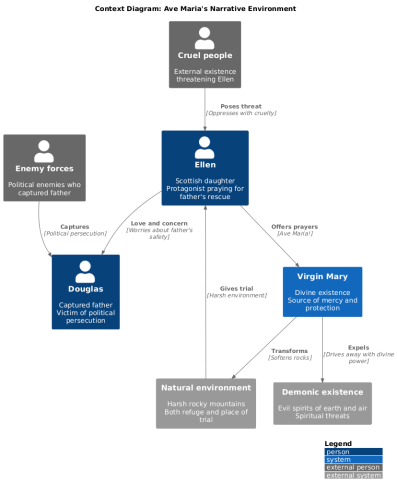
Figure 1. Context Diagram: Ave Maria's Narrative Environment.
@startuml
!include <C4/C4_Context>
title Context Diagram: Ave Maria's Narrative Environment
LAYOUT_WITH_LEGEND()
Person(ellen, "Ellen", "Scottish daughter\nProtagonist praying for father's rescue")
Person(father, "Douglas", "Captured father\nVictim of political persecution")
Person_Ext(enemies, "Enemy forces", "Political enemies who captured father")
Person_Ext(cruel_people, "Cruel people", "External existence threatening Ellen")
System(mary, "Virgin Mary", "Divine existence\nSource of mercy and protection")
System_Ext(natural_env, "Natural environment", "Harsh rocky mountains\nBoth refuge and place of trial")
System_Ext(demons, "Demonic existence", "Evil spirits of earth and air\nSpiritual threats")
Rel(ellen, mary, "Offers prayers", "Ave Maria!")
Rel(ellen, father, "Love and concern", "Worries about father's safety")
Rel(enemies, father, "Captures", "Political persecution")
Rel(cruel_people, ellen, "Poses threat", "Oppresses with cruelty")
Rel(mary, demons, "Expels", "Drives away with divine power")
Rel(natural_env, ellen, "Gives trial", "Harsh environment")
Rel(mary, natural_env, "Transforms", "Softens rocks")
LAYOUT_TOP_DOWN()
@enduml
3.3. Context Layer Analysis Results
3.3.1. Structural Findings
Dual-axis system: Vertical axis (Ellen-Virgin Mary) and horizontal axis (Ellen-father).
Opposition structure: Protective forces (Virgin Mary) vs. threatening forces (enemies, demons, nature).
Centrality: Ellen as the convergence point of all relationships.
3.3.2. Functional Characteristics
Setting boundaries of the narrative world.
Defining roles of major stakeholders.
Clarifying opposition structures
| [13] | Schreibman, Susan, Ray Siemens, and John Unsworth. "A New Companion to Digital Humanities." Wiley-Blackwell, 2016. |
[13]
.
4. Container Layer Analysis (Layer 2: Poetic Structure)
4.1. Functional Definition of Container Layer
The structural layer that manages internal organization of the poem, functional division of each stanza, and chronological development.
| [2] | "C4 Model for Software Architecture." https://c4model.com/ |
| [14] | Gold, Matthew K., and Lauren F. Klein. "Debates in the Digital Humanities 2019." University of Minnesota Press, 2019. |
[2, 14]
.
4.2. Container Layer PlantUML Model
@startuml
!include <C4/C4_Container>
title Container Diagram: Poetic Structure of Ave Maria
Person(ellen, "Ellen", "Subject of prayer")
System_Boundary(poem, "Ave Maria Poetic Structure") {
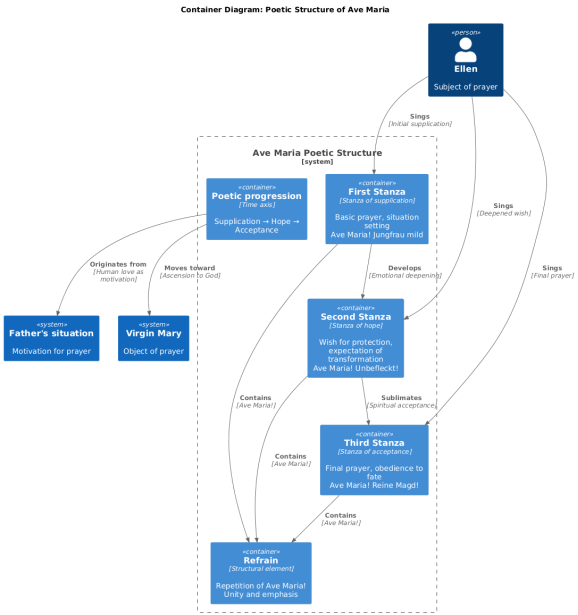
Container(verse1, "First Stanza", "Stanza of supplication", "Basic prayer, situation setting\nAve Maria! Jungfrau mild")
Container(verse2, "Second Stanza", "Stanza of hope", "Wish for protection, expectation of transformation\nAve Maria! Unbefleckt!")
Container(verse3, "Third Stanza", "Stanza of acceptance", "Final prayer, obedience to fate\nAve Maria! Reine Magd!")
Container(refrain, "Refrain", "Structural element", "Repetition of Ave Maria!\nUnity and emphasis")
Container(progression, "Poetic progression", "Time axis", "Supplication → Hope → Acceptance")
}
System(mary, "Virgin Mary", "Object of prayer")
System(father_situation, "Father's situation", "Motivation for prayer")
Rel(ellen, verse1, "Sings", "Initial supplication")
Rel(ellen, verse2, "Sings", "Deepened wish")
Rel(ellen, verse3, "Sings", "Final prayer")
Rel(verse1, verse2, "Develops", "Emotional deepening")
Rel(verse2, verse3, "Sublimates", "Spiritual acceptance")
Rel(verse1, refrain, "Contains", "Ave Maria!")
Rel(verse2, refrain, "Contains", "Ave Maria!")
Rel(verse3, refrain, "Contains", "Ave Maria!")
Rel(progression, mary, "Moves toward", "Ascension to God")
Rel(progression, father_situation, "Originates from", "Human love as motivation")
LAYOUT_TOP_DOWN()
@enduml
Figure 2. Containe Diagram: Poetic Structure of Ave Maria.
4.3. Container Layer Analysis Results
4.3.1. Structural Findings
Three-stage progression: Supplication (First stanza) → Hope (Second stanza) → Acceptance (Third stanza).
Circular structure: Unity through refrain "Ave Maria!".
Temporal development: Chronological progression from night (First stanza) → sleep (Second stanza) → morning (Third stanza).
4.3.2. Functional Characteristics
Gradual organization of poetic content.
Chronological management of emotional progression.
Balance adjustment between unity and change.
5. Component Layer Analysis (Layer 3: Emotional/Conceptual Elements)
5.1. Functional Definition of Component Layer
The element layer that controls the placement and interaction of emotional and conceptual components within each stanza.
5.2. Component Layer PlantUML Model
@startuml
!include <C4/C4_Component>
title Component Diagram: Emotional and Conceptual Structure of Ave Maria
Container_Boundary(verse1, "First Stanza: Supplication") {
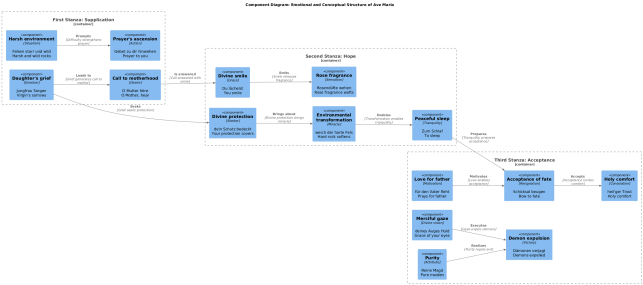
Component(grief, "Daughter's grief", "Emotion", "Jungfrau Sorgen\nVirgin's sorrows")
Component(maternal_call, "Call to motherhood", "Desire", "O Mutter höre\nO Mother, hear")
Component(harsh_env, "Harsh environment", "Situation", "Felsen starr und wild\nHarsh and wild rocks")
Component(prayer_ascent, "Prayer's ascension", "Action", "Gebet zu dir hinwehen\nPrayer to you")
}
Container_Boundary(verse2, "Second Stanza: Hope") {
Component(protection, "Divine protection", "Shelter", "dein Schutz bedeckt\nYour protection covers")
Component(transformation, "Environmental transformation", "Miracle", "weich der harte Fels\nHard rock softens")
Component(divine_smile, "Divine smile", "Grace", "Du lächelst\nYou smile")
Component(rose_fragrance, "Rose fragrance", "Sensation", "Rosendüfte wehen\nRose fragrance wafts")
Component(sleep_peace, "Peaceful sleep", "Tranquility", "Zum Schlaf\nTo sleep")
}
Container_Boundary(verse3, "Third Stanza: Acceptance") {
Component(purity, "Purity", "Attribute", "Reine Magd\nPure maiden")
Component(demon_expulsion, "Demon expulsion", "Victory", "Dämonen verjagt\nDemons expelled")
Component(graceful_eyes, "Merciful gaze", "Divine vision", "deines Auges Huld\nGrace of your eyes")
Component(fate_submission, "Acceptance of fate", "Resignation", "Schicksal beugen\nBow to fate")
Component(holy_comfort, "Holy comfort", "Consolation", "heil'ger Trost\nHoly comfort")
Component(paternal_love, "Love for father", "Motivation", "für den Vater fleht\nPrays for father")
}
' Internal relationships
Rel(grief, maternal_call, "Leads to", "Grief generates call to mother")
Rel(harsh_env, prayer_ascent, "Prompts", "Difficulty strengthens prayer")
Rel(protection, transformation, "Brings about", "Divine protection brings miracle")
Rel(divine_smile, rose_fragrance, "Emits", "Smile releases fragrance")
Rel(transformation, sleep_peace, "Enables", "Transformation enables tranquility")
Rel(purity, demon_expulsion, "Realizes", "Purity repels evil")
Rel(graceful_eyes, demon_expulsion, "Executes", "Gaze expels demons")
Rel(fate_submission, holy_comfort, "Accepts", "Acceptance invites comfort")
Rel(paternal_love, fate_submission, "Motivates", "Love enables acceptance")
' Inter-stanza relationships
Rel(grief, protection, "Seeks", "Grief seeks protection")
Rel(maternal_call, divine_smile, "Is answered", "Call answered with smile")
Rel(sleep_peace, fate_submission, "Prepares", "Tranquility prepares acceptance")
LAYOUT_LEFT_RIGHT()
@enduml
Figure 3. Component Diagram: Emotional and Conceptual Structure of Ave Maria.
5.3. Component Layer Analysis Results
5.3.1. Structural Findings
Emotional transition system: Gradual process of grief → hope → acceptance.
Sensory integration: Multi-layered expression of visual, olfactory, and tactile senses.
Divine response mechanism: Gradual response to human prayers.
5.3.2. Functional Characteristics
Systematic placement of emotional elements.
Management of causal relationships between components.
Maintenance of emotional continuity across stanzas.
6. Code Layer Analysis (Layer 4: Linguistic Techniques)
6.1. Functional Definition of Code Layer
The implementation layer of specific linguistic expressions, rhetorical techniques, and phonetic structures.
6.2. Code Layer PlantUML Model
@startuml
!include <C4/C4_Component>
title Code Diagram: Linguistic Technique Details of Ave Maria
Container_Boundary(linguistic, "Linguistic Techniques") {
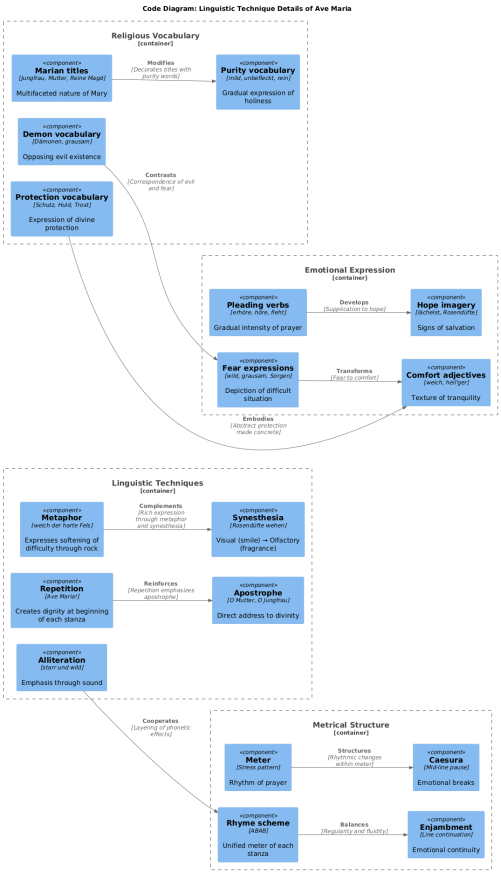
Component(repetition, "Repetition", "Ave Maria!", "Creates dignity at beginning of each stanza")
Component(apostrophe, "Apostrophe", "O Mutter, O Jungfrau", "Direct address to divinity")
Component(metaphor, "Metaphor", "weich der harte Fels", "Expresses softening of difficulty through rock")
Component(synesthesia, "Synesthesia", "Rosendüfte wehen", "Visual (smile) → Olfactory (fragrance)")
Component(alliteration, "Alliteration", "starr und wild", "Emphasis through sound")
}
Container_Boundary(religious, "Religious Vocabulary") {
Component(titles, "Marian titles", "Jungfrau, Mutter, Reine Magd", "Multifaceted nature of Mary")
Component(purity_words, "Purity vocabulary", "mild, unbefleckt, rein", "Gradual expression of holiness")
Component(protection_terms, "Protection vocabulary", "Schutz, Huld, Trost", "Expression of divine protection")
Component(demon_terms, "Demon vocabulary", "Dämonen, grausam", "Opposing evil existence")
}
Container_Boundary(emotional, "Emotional Expression") {
Component(pleading_verbs, "Pleading verbs", "erhöre, höre, fleht", "Gradual intensity of prayer")
Component(comfort_adjectives, "Comfort adjectives", "weich, heil'ger", "Texture of tranquility")
Component(fear_expressions, "Fear expressions", "wild, grausam, Sorgen", "Depiction of difficult situation")
Component(hope_imagery, "Hope imagery", "lächelst, Rosendüfte", "Signs of salvation")
}
Container_Boundary(structure, "Metrical Structure") {
Component(rhyme_scheme, "Rhyme scheme", "ABAB", "Unified meter of each stanza")
Component(meter, "Meter", "Stress pattern", "Rhythm of prayer")
Component(caesura, "Caesura", "Mid-line pause", "Emotional breaks")
Component(enjambment, "Enjambment", "Line continuation", "Emotional continuity")
}
' Relationships between techniques
Rel(repetition, apostrophe, "Reinforces", "Repetition emphasizes apostrophe")
Rel(metaphor, synesthesia, "Complements", "Rich expression through metaphor and synesthesia")
Rel(alliteration, rhyme_scheme, "Cooperates", "Layering of phonetic effects")
Rel(titles, purity_words, "Modifies", "Decorates titles with purity words")
Rel(protection_terms, comfort_adjectives, "Embodies", "Abstract protection made concrete")
Rel(demon_terms, fear_expressions, "Contrasts", "Correspondence of evil and fear")
Rel(pleading_verbs, hope_imagery, "Develops", "Supplication to hope")
Rel(fear_expressions, comfort_adjectives, "Transforms", "Fear to comfort")
Rel(meter, caesura, "Structures", "Rhythmic changes within meter")
Rel(rhyme_scheme, enjambment, "Balances", "Regularity and fluidity")
LAYOUT_LEFT_RIGHT()
@enduml
Figure 4. Code Diagram: Linguistic Technique Details of Ave Maria.
6.3. Code Layer Analysis Results
6.3.1. Structural Findings
1. Phonetic technique system: Strategic placement of alliteration and rhyme for musical effect
2. Religious vocabulary hierarchy: Gradual use of Marian titles (mild → unbefleckt → rein)
3. Integration of rhetorical techniques: Cooperation of metaphor, synesthesia, and apostrophe
6.3.2. Functional Characteristics
1. Implementation of specific linguistic expressions
2. Emotional amplification through phonetic effects
3. Multi-layering of meaning through rhetorical techniques
7. Inter-layer Interaction Analysis
7.1. Vertical Relationships (Hierarchy by Abstraction Level)
Context → Container → Component → Code
1. Narrative environment → Poetic structure → Emotional elements → Linguistic techniques
2. Gradual implementation from abstract to concrete
7.2. Horizontal Relationships (Intra-layer Cooperation)
Complex interactions among elements within each layer:
1. Context layer: Opposition structure and protective relationships
2. Container layer: Chronological progression and circular structure
3. Component layer: Emotional transition and sensory integration
4. Code layer: Phonetic techniques and rhetorical devices
7.3. Feedback Relationships (Influence from Concrete to Abstract)
1. Language choices in Code layer determine emotional effects in Component layer
2. Emotional placement in Component layer forms structure in Container layer
3. Progression in Container layer embodies narrative in Context layer
8. Conclusion
8.1. Clarification of Unique Functions of Each Layer
Through C4 Model individual decomposition, it was revealed that each layer has the following unique functions:
1. Context layer: Setting boundaries of narrative world and placement of stakeholders
2. Container layer: Chronological organization of poetic content
3. Component layer: Systematic management of emotional and conceptual elements
4. Code layer: Concrete implementation through linguistic techniques
8.2. Discovery of Inter-layer Cooperation Mechanisms
It was confirmed that while each layer maintains independence, they create integrated poetic effects through vertical, horizontal, and feedback-type multiple relationships.
8.3. Contribution to Literary Studies
The individual functions and interrelationships of each layer, which tend to be overlooked in conventional integrative approaches, have been systematically elucidated.
9. Future Research Development
9.1. Method Extension
1. Application of individual decomposition analysis to other poetic works
2. Investigation of correspondence with musical elements
3. Research on layer-specific structure preservation in translation
9.2. Technical Development
1. Development of automated analysis tools
2. Large-scale poetry collection analysis with AI assistance
3. Construction of interactive visualization systems
9.3. Interdisciplinary Applications
Collaborative research with musicology.
Contribution to digital humanities.
Application to foreign language education.
Abbreviations
C4 | Context, Container, Component, Code |
Acknowledgments
We express our deep gratitude to all concerned parties who have shown understanding in introducing knowledge from the field of software architecture in developing this new literary analysis method of C4 Model individual decomposition. We hope this research will contribute to the interdisciplinary development of literary studies and software engineering.
Author Contributions
Osamu Okumura is the sole author. The author read and approved the final manuscript.
Conflicts of Interest
The author declares no conflicts of interest.
References
| [1] |
Brown, Simon. "Software Architecture for Developers." LeanPub, 2012-2022.
|
| [2] |
"C4 Model for Software Architecture."
https://c4model.com/
|
| [3] |
"C4 Model Misconceptions, Misuses & Mistakes."
https://static.architectis.je/devoxxpl2023-c4-model.pdf
|
| [4] |
"PlantUML C4 Documentation." PlantUML Official Documentation.
|
| [5] |
Claude 3.2 Sonnet (Anthropic AI). "AI-Assisted Structural Analysis."
|
| [6] |
"HOME Classical Masterpieces: Schubert's 'Ave Maria'."
https://classic-fan.com/avemaria/
|
| [7] |
Okumura, Osamu. "Structural Analysis of Schubert's 'Ave Maria' Using the C4 Model." 2025.
|
| [8] |
Moretti, Franco. "Distant Reading." Verso Books, 2013.
|
| [9] |
Jockers, Matthew L. "Macroanalysis: Digital Methods and Literary History." University of Illinois Press, 2013.
|
| [10] |
Underwood, Ted. "Distant Horizons: Digital Evidence and Literary Change." University of Chicago Press, 2019.
|
| [11] |
Piper, Andrew. "Enumerations: Data and Literary Study." University of Chicago Press, 2018.
|
| [12] |
Drucker, Johanna. "The Digital Humanities Coursebook: An Introduction to Digital Methods for Research and Scholarship." Routledge, 2021.
|
| [13] |
Schreibman, Susan, Ray Siemens, and John Unsworth. "A New Companion to Digital Humanities." Wiley-Blackwell, 2016.
|
| [14] |
Gold, Matthew K., and Lauren F. Klein. "Debates in the Digital Humanities 2019." University of Minnesota Press, 2019.
|
| [15] |
Bode, Katherine. "A World of Fiction: Digital Collections and the Future of Literary History." University of Michigan Press, 2018.
|
Cite This Article
-
APA Style
Okumura, O. (2025). Schubert's "Ave Maria (Ellen's Song No. 3)": Poetic Structure Analysis Using the C4 Model. Humanities and Social Sciences, 13(6), 632-640. https://doi.org/10.11648/j.hss.20251306.23
 Copy
|
Copy
|
 Download
ACS Style
Okumura, O. Schubert's "Ave Maria (Ellen's Song No. 3)": Poetic Structure Analysis Using the C4 Model. Humanit. Soc. Sci. 2025, 13(6), 632-640. doi: 10.11648/j.hss.20251306.23
Copy
|
Download
AMA Style
Okumura O. Schubert's "Ave Maria (Ellen's Song No. 3)": Poetic Structure Analysis Using the C4 Model. Humanit Soc Sci. 2025;13(6):632-640. doi: 10.11648/j.hss.20251306.23
Copy
|
Download
-
@article{10.11648/j.hss.20251306.23,
  author = {Osamu Okumura},
  title = {Schubert's "Ave Maria (Ellen's Song No. 3)": Poetic Structure Analysis Using the C4 Model},
  journal = {Humanities and Social Sciences},
  volume = {13},
  number = {6},
  pages = {632-640},
  doi = {10.11648/j.hss.20251306.23},
  url = {https://doi.org/10.11648/j.hss.20251306.23},
  eprint = {https://article.sciencepublishinggroup.com/pdf/10.11648.j.hss.20251306.23},
  abstract = {This research conducts a multi-layered analysis of the poetic structure of Franz Schubert's "Ave Maria (Ellen's Song No. 3)" D.839 by individually decomposing each layer of the C4 Model (Context, Container, Component, Code). In contrast to the integrative approaches in traditional literary studies, this study aims to objectively elucidate the structural perfection of the work by individually examining the functions and interrelationships of each layer. The C4 Model, originally developed for software architecture visualization, provides a systematic framework for analyzing complex hierarchical structures. The analysis reveals a dual-axis structure in the Context layer, three-stage progression in the Container layer, emotional transition system in the Component layer, and strategic placement of linguistic techniques in the Code layer. Each layer maintains independence while producing an integrated poetic effect. The methodology employs PlantUML C4 notation for visualization and documentation, enabling precise structural mapping of poetic elements. This interdisciplinary approach demonstrates how computational methods can enhance literary analysis, offering new perspectives on classical works. The findings contribute to digital humanities scholarship by establishing a replicable framework for systematic poetic structure analysis that bridges software engineering principles with literary criticism.},
 year = {2025}
}
Copy
|
Download
-
TY  - JOUR
T1  - Schubert's "Ave Maria (Ellen's Song No. 3)": Poetic Structure Analysis Using the C4 Model
AU  - Osamu Okumura
Y1  - 2025/12/29
PY  - 2025
N1  - https://doi.org/10.11648/j.hss.20251306.23
DO  - 10.11648/j.hss.20251306.23
T2  - Humanities and Social Sciences
JF  - Humanities and Social Sciences
JO  - Humanities and Social Sciences
SP  - 632
EP  - 640
PB  - Science Publishing Group
SN  - 2330-8184
UR  - https://doi.org/10.11648/j.hss.20251306.23
AB  - This research conducts a multi-layered analysis of the poetic structure of Franz Schubert's "Ave Maria (Ellen's Song No. 3)" D.839 by individually decomposing each layer of the C4 Model (Context, Container, Component, Code). In contrast to the integrative approaches in traditional literary studies, this study aims to objectively elucidate the structural perfection of the work by individually examining the functions and interrelationships of each layer. The C4 Model, originally developed for software architecture visualization, provides a systematic framework for analyzing complex hierarchical structures. The analysis reveals a dual-axis structure in the Context layer, three-stage progression in the Container layer, emotional transition system in the Component layer, and strategic placement of linguistic techniques in the Code layer. Each layer maintains independence while producing an integrated poetic effect. The methodology employs PlantUML C4 notation for visualization and documentation, enabling precise structural mapping of poetic elements. This interdisciplinary approach demonstrates how computational methods can enhance literary analysis, offering new perspectives on classical works. The findings contribute to digital humanities scholarship by establishing a replicable framework for systematic poetic structure analysis that bridges software engineering principles with literary criticism.
VL  - 13
IS  - 6
ER  -
Copy
|
Download





 Share This Article
 Twitter
 Linked In
 Facebook